In short: A boo chain runs on visibility and on timing. The sign in the window is what makes it public, and your start date decides how far it travels before Halloween. Everything after that — the doorbell, the signature, the way you bow out — is convention.
We write buying guides, not lab reviews: we have not tested every product on this page. Prices, availability and ratings change constantly — whatever Amazon shows when you click is the authoritative figure.
Most boo basket writing is about the contents. This page is about the game being played outside, which has its own moving parts and its own ways of stalling.
You already know the mechanic: a filled container appears on a doorstep, a sign goes in the window, and that household boos two more homes. Everything below assumes it.
One thing to say plainly, once: nobody governs this. What follows is our own convention, drawn from how the tradition is commonly described, and it varies street to street. Where we give a working answer, read it as an opinion you are free to overrule.
With no street-facing window, tape the sign inside the storm door or hang it on the handle.
The sign does the work
Of everything a boo chain involves, only the sign is public.
TODAY described the mechanic in October 2024. Families were "secretly leaving boo baskets on their neighbors' doorsteps," with notes reading "You've been BOOed!" included. Those notes carried instructions for "paying it forward" by leaving a basket for another neighbor.
Taped in a window, that sheet is the closest thing a street has to a shared record. Everything else in the tradition happens after dark and behind a front door. That is why a chain can run for a fortnight with much of the block unaware of it.
A neighbor who has never heard of any of this finds out by reading somebody's window, so where the sign goes matters as much as whether you include one.
This article contains affiliate links. If you buy through one, we earn a small commission at no extra cost to you. We only recommend what we would suggest to a friend. Our affiliate disclosure sets out the terms.
Print it on something that will hold up. Plain white cardstock takes tape better than copy paper, and a laminating pouch keeps it readable after a walk over in the rain. A blank door hanger covers the house whose windows all face the yard.
A basket handed over with your name on it is a gift, and a good one. It just is not a boo, because nothing passes on from it.
The October calendar
Timing is the part people get wrong, and the reason is arithmetic rather than manners.
A chain doubles. Two households become four, four become eight. Our own estimate for one round is most of a week, because somebody has to notice the basket, then shop, then find a free evening.
Run that estimate from the first week of October and three or four rounds fit before Halloween. The figure is ours, derived from the week-long estimate above, and a slower street gets fewer. Start in the last week and one round is all that remains, so the thing stops with the two houses you booed.
The one-off named basket carries none of that. Any October evening works.
Evening is the other half of the question. Between dinner and bedtime is the window most drops seem to aim for, and our working band is 6:30 to 8:30. We stop at nine, on the view that a doorbell later than that is an intrusion we would not want ourselves.
Ring, knock, or neither
Three delivery methods, and each buys something at a price.
Ring and go. The version we would default to. Ringing is what we would rely on to get the basket picked up the same evening, and walking away is what keeps it anonymous.
Knock and step back. Quieter, and it fails on a heavy front door. If nobody answers you are stuck deciding whether to knock again or abandon the thing on the step.
Silent drop, then a text. The version for a house with a dog, or with somebody working nights. You lose the surprise, and you gain the one method where you know the basket comes in before the weather finds it.
Dogs are worth checking for before you choose. A bell at eight in the evening starts a bark that carries through a house, and in a small building it carries through several of them. When you can hear a dog through the door, knock softly or skip the noise entirely.
Situations, and what we would do
Below are the etiquette questions, with the call we would make on each. None of these is a rule.
| The situation | What we would do |
|---|---|
| You do not know their names | Tag it to the house number — "our neighbors at 14" — and skip the guess |
| A window sign is already up | Walk on to the next house |
| The house has no kids | Boo them anyway, with adult contents |
| Somebody there works nights | Silent drop, no bell, a text or a note afterwards |
| You got booed twice | Move the sign to the window nearest the street, at eye height from the sidewalk |
| Nobody has booed you | Start it yourself, or let it go |
| The porch is full of parcels | Write "You've been booed" large on top, so it is not sorted in with the deliveries |
| You want your name on it | Sign it, and leave the pass-it-on sheet out |
One thread runs through all eight, and it is our working assumption rather than a measured one: the easier a chain is to join, the longer it runs.
A street, a classroom, an office
Venue changes this format more than the recipient does.
A street. The loosest version, and the only one where anonymity, the window sign, and the doorstep all apply at once. No account of the tradition we have read describes a street agreeing a budget, which is why the first basket quietly sets one. The risk we would plan around is that your number becomes the reference point for whoever goes next.
A classroom. Run by the teacher or not at all. Ask before anything comes through the door. Where a class has a policy on food and outside items, following that policy is the whole job, and it is not yours to second-guess.
An office. Keep it opt-in, with a list people add their own name to. Landing a chain on a colleague who never signed up is an obligation with your name on it. Where the workplace has its own rule about food brought into shared spaces, that rule decides the contents.
Spend caps and the rest of the workplace etiquette sit in our coworker and teacher section.
When the chain reaches a house that will not play
Assume at least one household will want out. That is a normal outcome and no failure of the tradition.
A graceful exit is already built into the format, and the pillar guide sets it out. We will not restate it here.
What that leaves is the half version, which nobody writes down. Pass on one basket instead of two and the chain stops doubling but keeps moving, which suits a week you do not have. Boo one household back and stop there, and you have had a good evening without starting anything at all.
The instruction sheet is the other lever, and it is the one nobody edits. Plenty of the printable versions we have seen read like a summons, with deadlines and consequences set in a spooky font. Rewrite that part in your own words before it goes anywhere.
Say outright that passing it on is optional, in one line near the top, where somebody skimming will still catch it.
The filler question, kept short
Mechanics are this page's job, so the picks live elsewhere. Our five-part method covers what goes in one and how the layers scale.
A chain basket narrows fast under two constraints, and both come from the anonymity.
You cannot ask anybody anything, which is the first one. Non-food picks that need no size settle that outright.
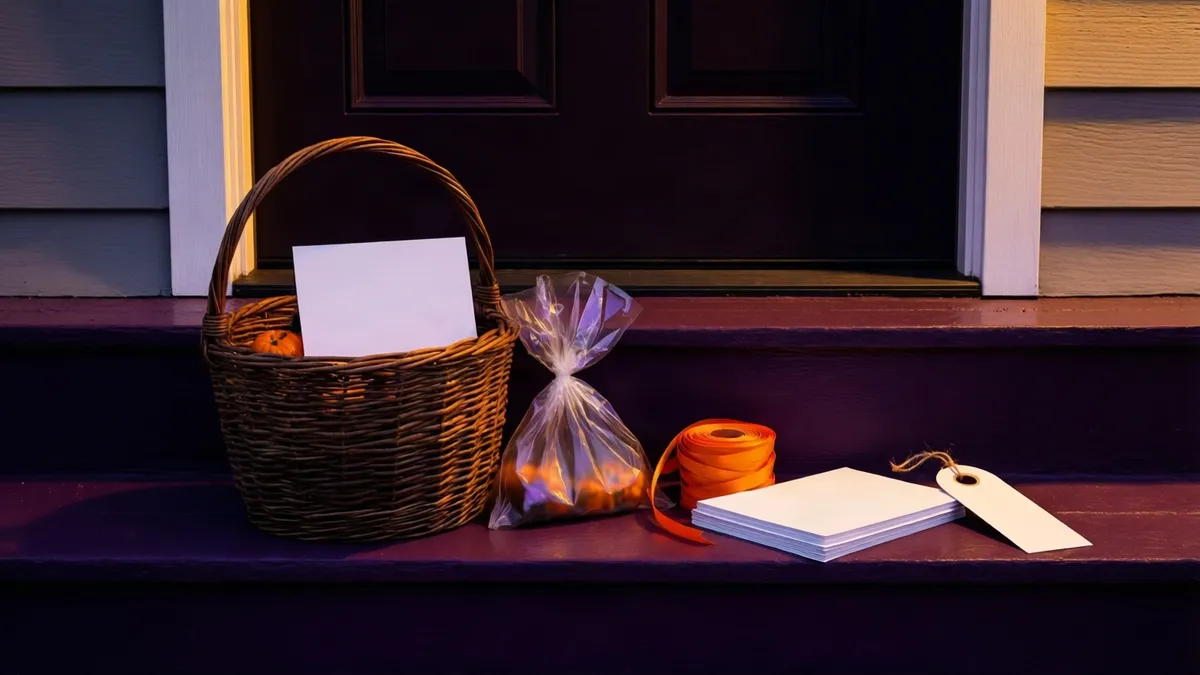
Waiting outside for a while is the second. Clear treat bags with ties keep the contents together if the container tips. A length of orange curling ribbon knotted over the top also tells the household this was left deliberately, rather than dropped by a courier.
One note for a household with kids in it. The American Academy of Pediatrics (AAP) advises waiting until children are home to sort and check treats before eating them, and throwing away anything spoiled, unwrapped, or suspicious.
That guidance is written about trick-or-treat candy. Applying it to a basket from a neighbor you have never met is our own call, and it is why we would keep everything edible commercially wrapped.
Building a named basket for a partner instead? The girlfriend guide and the boyfriend guide both start from the person rather than the street.
Frequently asked questions
How many houses should you boo?
Two is the number named on the instruction sheets we have seen, and two is what makes a chain double. One is fine if two is a stretch on your week. Going past two from a single household can outrun what the rest of the street is able to keep up with.
What do you write on the instruction sheet?
What a boo basket is, and that the household can boo two more homes if they want to. Where the sign goes, and that none of it is compulsory. Keep the whole thing to one side of a page. Our guess is that the long sheets, the ones with rules on them, are what end up in a drawer.
Should you boo a house you have never spoken to?
Yes, and that is arguably the point of an anonymous drop. Proximity is the rule we would use over friendship, since a chain spreads along a street and not along a contact list. Nothing in the format asks you to know who lives there.
What if the house never puts the sign up?
Nothing happens, and that is allowed. The sign is the street's coordination tool, not a receipt you are owed. If a house stays quiet, treat it as booed and move on. Do not send a second basket to prompt anybody.
Can adults boo each other, or is it just for kids?
Nothing about the format is limited to children. Contents change completely; the mechanics do not. Anonymous drop, window sign, pass it on to two.
How do you start a boo chain on a street that has never done it?
Print a clear instruction sheet with obviously optional wording, then boo two houses in the first week of October. Our own expectation for a first year is one or two rounds and no more, which is enough for the sign to be recognized next October.
Morgan Hale writes about seasonal gifting formats for Boo Baskets. The about page covers our sourcing standard, and Morgan's author page has the rest.
Sources
- TODAY (NBCUniversal), "What are 'boo baskets'? Parents debate this love-or-hate Halloween tradition," October 15, 2024 — today.com (retrieved August 20, 2026)
- American Academy of Pediatrics (HealthyChildren.org), "Halloween Fun & Safety Tips for Kids of All Ages," last updated October 14, 2025 — healthychildren.org (retrieved August 20, 2026)