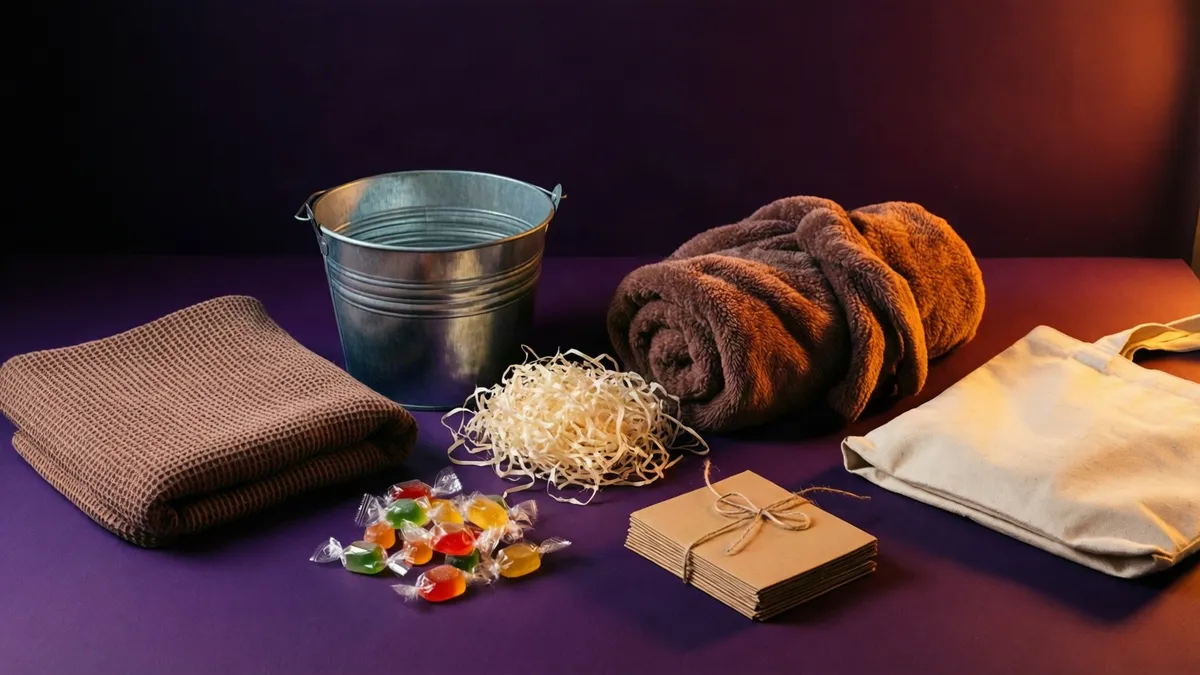
In short: Five decisions build a boo basket. A container, one anchor item, a cozy layer, a candy layer, and one personal touch. Make them in that order and the basket assembles itself, at any budget, without a shopping list open in the other tab.
We write buying guides, not lab reviews: we have not tested every product on this page. Prices, availability and ratings change constantly — whatever Amazon shows when you click is the authoritative figure.
This page is the method. If you would rather browse finished picks, our fifty boo basket ideas do that job.
The formula is worth learning because it travels. Same five layers, different aisle, and you can build one in a drugstore at nine at night.
This article contains affiliate links. If you buy through one, we earn a small commission at no extra cost to you. We only recommend what we would suggest to a friend. Our affiliate disclosure has the full terms.
The formula in one table
Each layer answers a question. Skip one and you get a specific, predictable failure — not a vaguer basket.
| Layer | The question it answers | What fails if you skip it |
|---|---|---|
| Container | Where does this live once the candy is gone? | Nothing holds its shape and the gift arrives as a pile in a bag |
| Anchor | What is this basket actually about? | Five small things with no center, and no way to read your intent |
| Cozy layer | Why does it feel like October? | The basket looks thin and half-empty, whatever it cost |
| Candy layer | What do they open tonight? | It stops reading as a Halloween gift |
| Personal touch | Why is it from you? | Anyone could have sent it |
One constraint sits underneath all five. A step in October is a hostile place to leave anything, and what a porch does to a basket rules out whole categories before you start.
Layer one: the container
Pick this first, because everything else has to fit inside it.
The container is not packaging. It is the first gift, and the one the recipient still has in February.
That reframe changes what you buy. Think of a woven basket that holds blankets by a couch, or a galvanized bucket that ends up under a sink. Both keep working. A crackly plastic pail with a printed pumpkin does not.
So the real decision is reusable or disposable, and it costs you either way. Reusable takes more up front and absorbs part of your anchor money. Disposable frees that money for the contents, and honestly, for a kid the printed pail is often the point.
Size is where people go wrong. Buy a container bigger than your budget and it will look under-filled no matter what you do. Tissue paper does not fix a bucket you cannot afford to fill.
Buy small and pack it tight, so the basket reads as full rather than as started.
Woven storage baskets work for a handover indoors. Galvanized buckets handle a wet step better than anything woven.
Layer two: the anchor
The anchor is the one item the basket is built around. Roughly half your spend goes here.
Everything else is chosen after it and in reference to it. That is the whole function: it gives the other four layers something to agree with. Buy two anchors and you have a haul instead of a gift.
Choosing blind is the hard case — a coworker, a neighbor, a boyfriend's roommate you have met twice. Three questions get you most of the way there without asking anyone anything.
What do they already own a worn-out version of? A blanket with a hole in it, slippers flattened at the heel, a chipped mug. Replacing something visibly on its last month is close to unlosable.
Buy the routine, not the personality. People are hard to shop for. Mornings are not. Someone who leaves at 6 a.m. drinks something on the way, and that is a category with an obvious answer.
Will it still be in use in November? Halloween-printed anchors get shelved on the first. Seasonal color, yes. Seasonal cartoon, only for the person who genuinely wants it in July.
Skip sizing when you cannot ask. Waffle-knit throws and plush robes fit everyone, which is why they anchor so many of these.
Layer three: the cozy layer
Soft, unsized, and it does not spoil. Those three conditions define the middle of the basket.
Socks, a scarf, a small throw, a knit headband, folded pajama pants. None of them need a measurement, none of them care about temperature, and all of them compress and expand to fill whatever space is left.
That last property is what this layer is really for. A thin basket reads as thin because the contents sit flat at the bottom. Fold a cozy item into the base and everything above it lifts to the rim.
Shredded paper filler does the same job, with one difference that matters: it stays behind in the recycling, and a pair of socks does not.
Keep it to one or two pieces. Three soft things start to feel like a laundry pile.
Layer four: the candy layer
Proportion is the only rule here. Candy fills maybe a quarter of the volume and much less of the spend.
Over-fill it and the basket becomes a bag of Halloween candy with a blanket on top, which is a thing the recipient already has access to. Under-fill it and something is obviously missing on the one holiday built around candy.
Always include one version that survives an afternoon on a doorstep. Commercially sealed, shelf-stable, not chocolate if the daytime high is still warm. Individually wrapped gummies hold up where a chocolate bar turns into a decision about whether to hand it over in person.
One allergen note, stated once. You cannot check a stranger's kitchen, which is why a commercially wrapped item is the only kind that answers the question for you. The label travels with it; an unwrapped piece in a bowl does not.
Guidance from the U.S. Food and Drug Administration (FDA) tells parents not to let children eat anything that is not commercially wrapped. We read that as the standard for the person packing, too. When it is a child's basket and you can ask the parent, ask.
Layer five: the personal touch
This is the layer that makes the basket come from a person rather than a shop.
A tag with their name on it is the minimum, and it does more than its cost suggests. A folded note beats a printed card. Naming something specific beats both — a date in October you are planning, an inside joke, the snack they mentioned once in a group chat.
Avoid the generic message. "Happy Halloween!" is what the store already printed on the bag.
If the basket is anonymous, a "You've Been Booed" sign is the personal layer, and the whole tradition rests on it. If it is signed, write the note last, once you can see what is in the basket. Kraft gift tags tie onto a handle, and blank ones leave room for the handwriting that does the work.
How the five layers scale
The bands below are ours and they describe a whole basket, not one item. No survey publishes an average boo basket price, so treat these as planning numbers you can move.
Here is the useful part: three of the five layers barely change between a $15 basket and a $60 one.
| Layer | Around $15 | Around $30 | Around $60 |
|---|---|---|---|
| Container | Paper bag or a bowl you own | Printed pail or a small basket | Reusable basket, crate, or tote |
| Anchor | None — the cozy item stands in | One modest keeper | One real keeper, half the total |
| Cozy layer | Socks | Socks or a scarf | A throw, doubling as the base |
| Candy layer | One bag | One bag | One bag, maybe two |
| Personal touch | A written note | A written note | A written note |
The anchor absorbs almost all of the money. Candy and the note stay flat, which surprises people who assume a bigger budget means more candy.
At $15 you are not building a smaller version of the $60 basket. You are building a different basket, where the cozy item is promoted to anchor and the theme does the rest of the work. One color and one running joke will carry it.
At $60 you are no longer filling a basket; you are presenting one item and the basket is how it arrives. Decide that on purpose rather than by accumulation.
For scale, the National Retail Federation (NRF) put planned Halloween spending in 2025 at $114.45 per person across costumes, decor, candy, and cards. A $60 basket is a large share of one person's whole Halloween.
What to check before anything goes in
Two labels, both on the back of the box, both taking about four seconds.
First, the age grading: the manufacturer's own statement about who the item is for. When your instinct and the box disagree, the box is the one you can point to.
Second, the small-parts warning, set by the U.S. Consumer Product Safety Commission (CPSC). For children under three, check the packaging for small-parts warnings before adding an item: the CPSC's small-parts rule exists because anything that fits through a 1.25-inch tube is a choking hazard.
On food and small toys the American Academy of Pediatrics (AAP) goes further. It holds hard, gooey, or sticky candy, gum, nuts, and small-part toys to age four or older, and balloons to eight.
Read both. Where they disagree with each other, the stricter one is the one to follow.
The three ways a basket goes wrong
Almost every disappointing basket is one of these three.
Too many small things and no anchor. Nine items under $6 cost the same as one good one and read as a clearance shelf. The recipient cannot tell which part was the idea. Cut it to five and put the difference into one object.
Everything perishable. A basket made entirely of candy, baked goods and a coffee drink is gone by Sunday, and a week later there is nothing to point at. At least one layer should still exist at Thanksgiving.
A container that is really packaging. Cellophane, a cardboard tray and a paper bag are not a container; they are what the container came in. If the recipient's first job is finding somewhere to put the wrapping, you spent money on the part that goes in the trash. A canvas tote sits in the same band and outlives the occasion.
Building one from what is already in the house
The formula does not require a shopping trip. Every layer has a version already in your kitchen or your closet.
Container. A mixing bowl, a colander, a picnic basket, a canvas tote from a conference, a milk crate. Wrapped in a dish towel, a bowl reads as deliberate.
Anchor. Harder to fake, and this is where a small purchase earns its place. The honest substitute is something with a plan attached: a movie night written on a card, a promised drive to the pumpkin patch.
Cozy. New socks from the drawer. A scarf you own two of. A folded blanket from the linen closet, which also becomes the base layer.
Candy. The multipack bag opened and split across two baskets.
Personal. Free, and the layer that decides how the whole thing lands.
A basket built entirely from the house still hits five for five. Same format, spring instead of fall? The layers work the same way in an Easter basket.
FAQ
Does the number of items matter?
Five layers, which usually means five to seven physical items once the container is counted. Nothing obliges you to hit a number. One anchor plus three supporting things and a note is a complete basket.
What is the one thing every boo basket needs?
The personal layer. A tag, a note, or a "You've Been Booed" sign for the anonymous version. Everything else is negotiable, including candy.
Do the five layers work for a man's basket?
Yes, and the layers are why it works. Anchor on something he uses, keep the cozy layer plain rather than seasonal, pick the candy he actually buys, and write the note. The formula is identical; only the aisle changes.
Can you build a boo basket without candy?
You can. For a doorstep drop to a household you do not know, it settles the allergy problem outright — a stranger's kitchen is not something you can check. Non-food fills the volume perfectly well. The other four layers carry it.
What should you not put in a boo basket?
Anything that needs a size you are guessing at, anything that leaks, anything perishable if it will wait outside, and anything printed with a date. Home-baked goods are also a no for a basket going to someone you do not know well.
Morgan Hale writes about seasonal gifting formats for Boo Baskets. The about page covers our sourcing standard, and Morgan's author page has the rest.
Sources
- U.S. Consumer Product Safety Commission, "Office of Compliance Small Parts Regulations — Toys and Products Intended for Use By Children Under 3 Years Old" — cpsc.gov (retrieved August 20, 2026)
- U.S. Food and Drug Administration, "Halloween Food Safety Tips for Parents," content current as of March 5, 2024 — fda.gov (retrieved August 20, 2026)
- American Academy of Pediatrics (HealthyChildren.org), "Choking Prevention for Babies & Children," last updated February 27, 2026 — healthychildren.org (retrieved August 20, 2026)
- National Retail Federation, "NRF Consumer Survey Finds Halloween Spending to Reach Record $13.1 Billion," September 18, 2025 — nrf.com (retrieved August 20, 2026)